
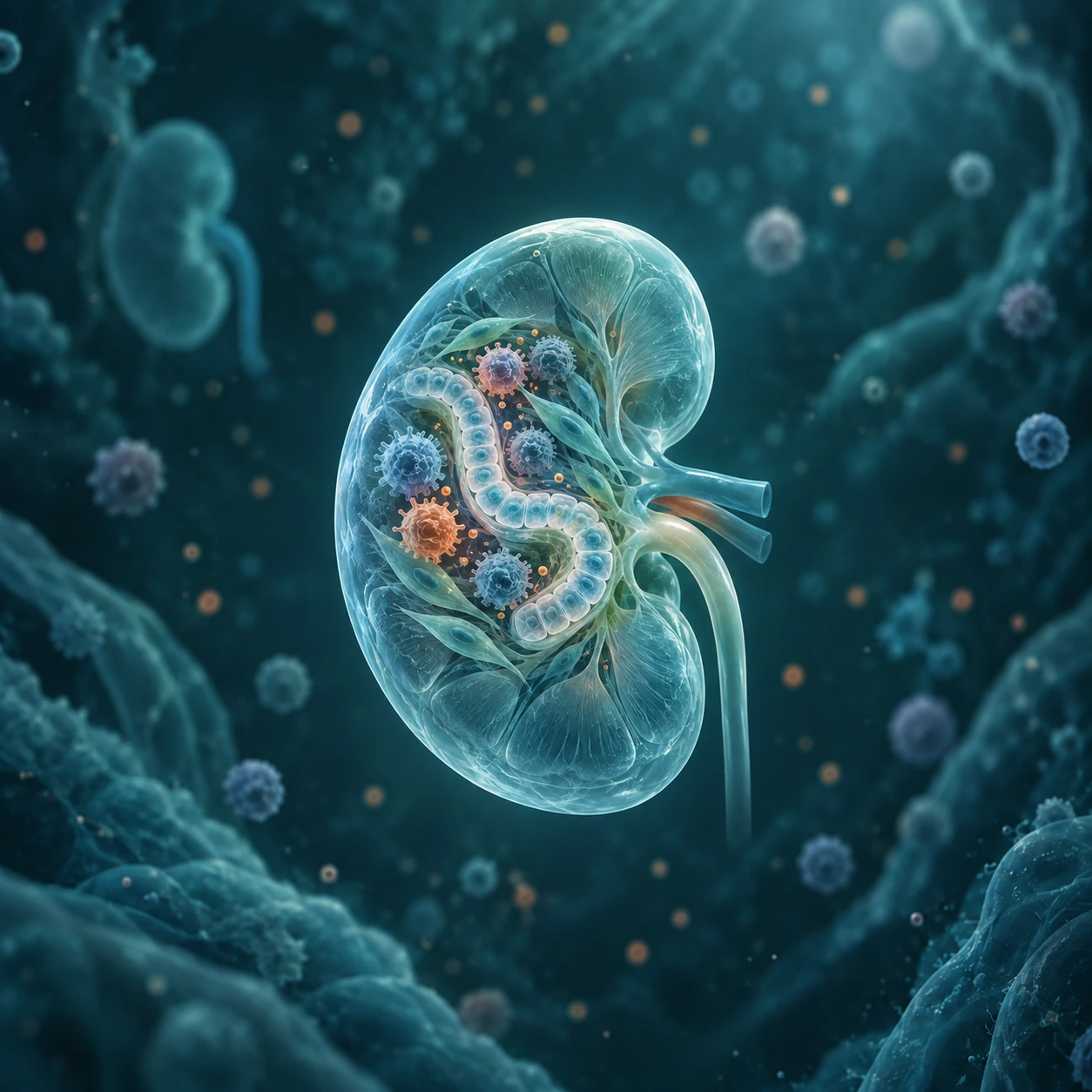
After acute injury, a kidney may recover or enter a path of persistent damage and fibrosis. A review published in Nature Reviews Nephrology on September 10, 2026 places interactions among kidney tubular epithelial cells, immune cells and fibroblasts at the center of repair outcomes.
Surviving cells can still follow different paths
According to the public abstract and key points, surviving tubular epithelial cells can proliferate and restore tissue integrity, but may also enter persistent cell-cycle arrest, senescence and pro-inflammatory, pro-fibrotic states. These abnormal states can affect surrounding immune cells and fibroblasts; continuing interactions may drive excessive extracellular-matrix deposition. Review abstract and key points
This framework separates repair into a continuous sequence: whether cells survive, which states they enter and how they influence surrounding tissue. Structural recovery and recovery of cell state become questions to follow in parallel.
The review organizes existing mechanistic research. It points toward tracking relationships among different cells over time, rather than judging tissue improvement at a single moment.
Repair research needs to ask what happens afterward
TASCAP’s editorial view is that the important continuing question is whether repair is sustained: does tissue function improve alongside a change in cell state, and do abnormal signals persist after short-term changes?
Such a mechanistic framework can help formulate experimental questions. The effects of a specific treatment still require relevant human studies. This review does not present a new clinical treatment result.