
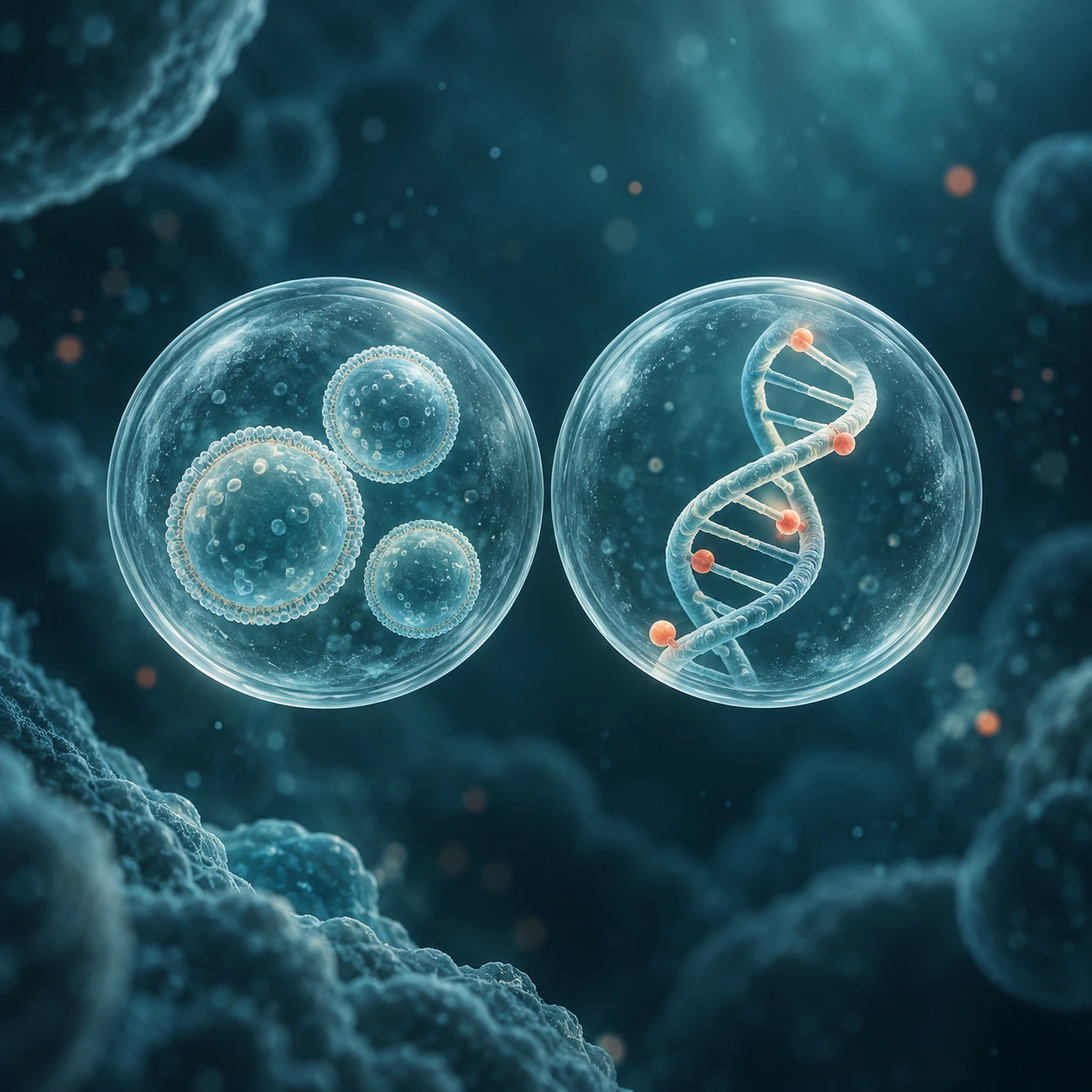
How might communication between cells affect the skin’s epigenetic age? A review in The Journals of Gerontology: Series A discusses extracellular vesicles and age clocks within one conceptual framework. First published on July 17, 2026 and included in the September issue, it produced no new experimental data.
Direct evidence between the two research strands remains limited
The review discusses communication mediated by extracellular vesicles (EVs) and epigenetic clocks that estimate age from features such as DNA methylation. This includes potential links between a class of EVs the authors call exosomes and the state of recipient cells.
The authors explicitly note that direct evidence in skin is limited, findings in other tissues offer indirect support, and the article is a hypothesis-generating conceptual framework. Original review
Such a framework organizes scattered studies into questions that can be tested further. Its connections need to be verified step by step in specific skin models before the observations can be shown to be meaningfully related.
Beyond a clock change, skin-function outcomes are needed
An age clock converts a set of molecular features into an estimate. Even if a future intervention changes that number, it will still be necessary to establish whether the clock is suitable for the tissue and whether the change accompanies reproducible functional improvement. The review therefore recommends prioritizing DNA-methylation clocks validated for skin.
The follow-up experiments TASCAP would look for should identify the EV source, direct molecular measurements in skin and independent functional outcomes together. As these links are established, the conceptual relationship may develop into an empirical explanation of skin aging. The current review has not demonstrated that any material reverses the age of human skin.